

The wash basin is the one thing in a bathroom that gets touched every single day, usually before anyone is properly awake. Get it right and the room feels calm and easy to use. Get it wrong and you spend years bumping your elbows, mopping splashes off the floor or scrubbing a rim you can never quite reach.
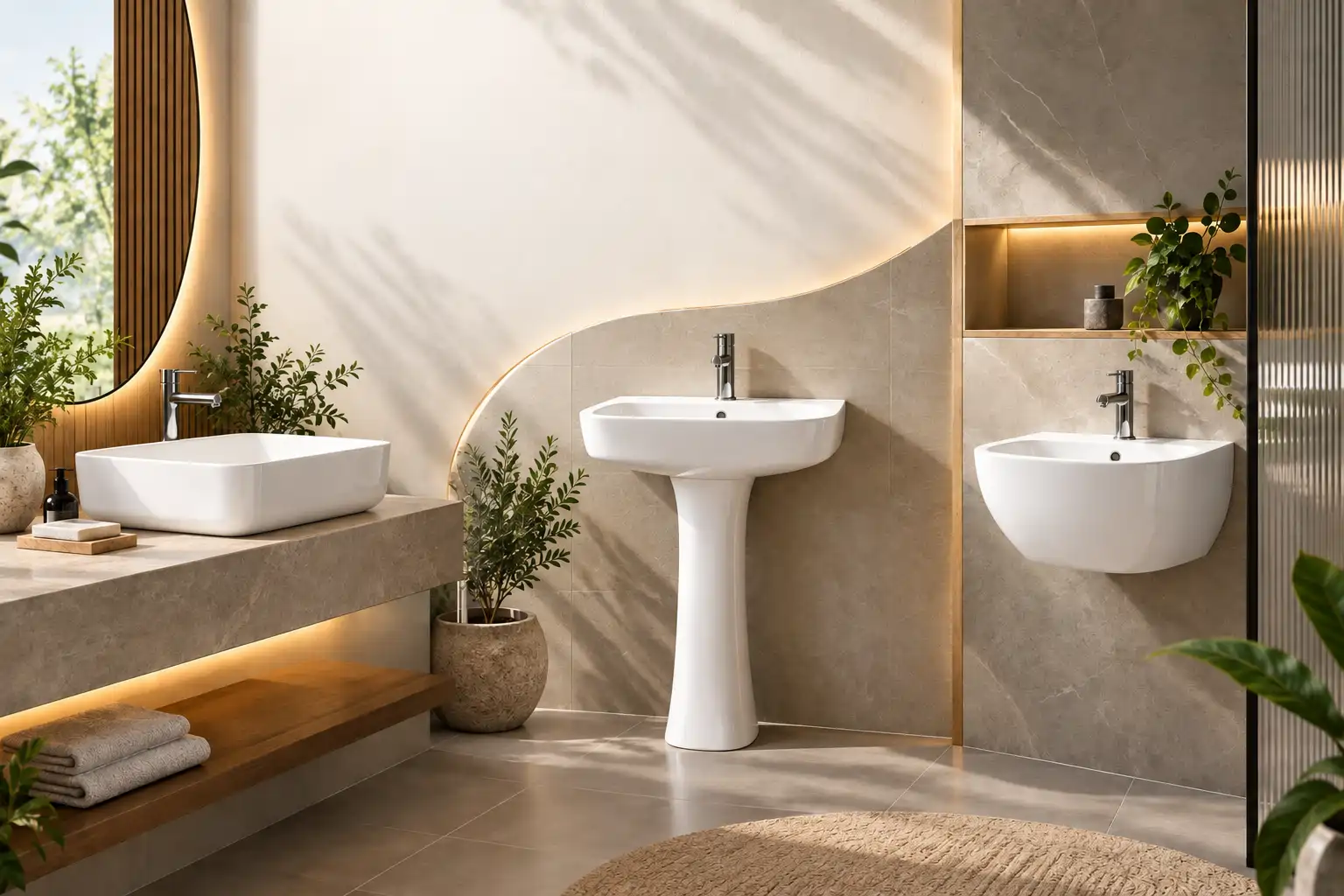
The choice mostly comes down to four families: table top, counter, pedestal and wall hung. Each one suits a different kind of bathroom, and the right answer has less to do with looks than with how much space you have, where your plumbing already sits and who uses the room.
The short answer
- Small bathroom, plumbing in the wall: a wall hung basin keeps the floor clear.
- Small bathroom, plumbing in the floor: a pedestal basin hides the pipes without any building work.
- You want storage under the basin: a table top or counter basin on a vanity unit.
- Guest bathroom you want people to notice: a designer table top or a one piece pedestal.
- Hotel or office washroom: wall hung or half pedestal, because cleaning staff need to get a mop underneath.
Now the detail behind each of those.
1. Table top basins
A table top basin sits on top of a counter or vanity like a bowl on a table. It is the style most people picture when they think of a modern bathroom, and it gives you the widest choice of shapes and finishes, from plain white rectangles to matt finishes and patterned designer pieces.
What is good about them: you get the full cupboard underneath for storage, the basin itself becomes the feature of the room, and replacing one later is simple because the counter stays where it is.
What people forget: the basin adds its own height on top of the counter. A normal vanity is around 800 to 850 mm high, and a table top basin can add another 120 to 150 mm on top of that. If you fit one on a standard counter, the rim ends up near chest height for a shorter adult and out of reach for a child. The fix is easy but has to be planned: drop the counter to roughly 700 to 750 mm so the finished rim lands around 850 mm.
You also need a taller tap, and a joint where the basin meets the counter that has to be kept sealed and clean.
2. Counter basins
A counter basin is set into the counter rather than standing on it, either dropped in from above or fixed underneath. Under counter fitting is the one to pick if cleaning matters to you, because there is no rim to trap water. You wipe straight from the counter into the bowl.
This style suits family bathrooms and any counter made of granite, quartz or solid surface, where the cut-out can be made accurately. The trade-off is commitment: the cut-out is shaped to that particular basin, so changing to a different model later usually means changing the counter too.
3. Pedestal basins
The pedestal basin is the classic: a bowl with a ceramic column underneath that hides the waste pipe and supports some of the weight. It has stayed popular for a simple reason. It needs no vanity, no carpentry and no special wall, so it works in an older bathroom where the plumbing comes up through the floor.
If you want the same idea with a cleaner silhouette, a one piece basin moulds the bowl and pedestal into a single shape, with no joint line between them.
The honest downside: no storage, and cleaning around the base of the column is a job nobody enjoys.
4. Half pedestal basins
A half pedestal is the middle path. The basin is fixed to the wall, and a short ceramic shroud covers the trap and pipework without reaching the floor. You get the tidy look of a pedestal and a clear floor that a mop can pass under.
Because the wall carries the weight, this one needs a solid wall or proper backing. A hollow partition wall needs support behind the board before the basin goes on.
5. Wall hung basins
A wall hung basin floats clear of the floor completely. In a small bathroom this is the single best trick for making the room feel bigger, because the eye reads the empty floor as space. It also sets you free on height, which matters if the basin is for children or for someone who uses a wheelchair.
There is also a hybrid worth knowing about: a wall hung table top basin that can be mounted either way, which is useful when the fitting decision is made late.
The catch is the same as the half pedestal, only more so. Everything depends on the wall and the brackets, and the waste pipe is on show unless you box it in or use a bottle trap you are happy to look at.
Measure these five things before you buy
Most basin regrets are measurement regrets, not style regrets.
- Rim height. Around 800 to 850 mm from the floor to the top of the basin suits most adults. Lower it for a children's bathroom.
- Elbow room. Leave roughly 200 mm of clear space on each side of the basin, and about 600 mm in front of it, so the room does not feel tight.
- Tap holes. Basins come with one hole, three holes or none at all. A basin with no hole needs a wall mounted tap, and that decision has to be made before the wall is tiled.
- The waste and trap. Check where your existing waste pipe comes out of the wall or floor, and whether your trap is a bottle trap or a P-trap. This is the detail that most often turns a simple basin swap into a plumbing job.
- The wall. For anything wall hung, check what is actually behind the tiles. A basin full of water is heavier than people expect.
Keeping it looking new
Whichever type you choose, the glaze is what keeps a basin looking good, and glaze is tougher than people think but not indestructible. A daily wipe with a soft cloth and mild detergent is all a glazed ceramic basin needs.
What actually damages it is the harsh stuff: scouring powder, wire scrubbers, and strong acid cleaners left sitting in the bowl. Those dull the surface over time, and once the shine goes, dirt starts to cling where it used to slide off. Matt finishes need the same gentle care, with a little more attention to drying, because water marks show more readily on matt than on gloss.
So which one should you buy?
If you are fitting out a small flat or a guest bathroom, go wall hung or half pedestal and enjoy the floor space.
For a family bathroom, a counter basin on a vanity earns its place, because the storage underneath solves the clutter problem that families always have.
In a hotel or a commercial washroom, wall hung is usually the practical answer. Cleaning is faster, and there is less to damage.
And if the bathroom is meant to make an impression, a designer table top basin does more for a room than almost anything else you can buy at the same price.
Still weighing it up? Browse the full basin range on our sanitaryware page, or send us your bathroom measurements and we will point you to the models that fit.